No one quite remembers when the formal conference began, though some recollections place its origins in a meeting among Latin American and European scholars that took place in 2006 in Puebla, Mexico. Despite these ambiguous origin stories, what is recalled distinctly among the founding members of the Latin American and European Meeting on Organisation Studies (LAEMOS) conference is the visionary energy and collaborative leadership of the Mexican intellectual: Eduardo Ibarra Colado. Ibarra Colado’s presence in LAEMOS was not cemented nor centralised and oral histories reveal the negotiations and strategies of local organisers that tried ‘bringing him back in’ or re-centering his work at the LAEMOS meetings.
Between 2006 and 2008, founding members of LAEMOS wrote a conference constitution that was developed collaboratively and outlined the priorities of centring Latin American scholarship and critical perspectives. This document appears to have been lost over time and left the subsequent organising committees with little consistency of purpose despite the efforts undertaken by individual organizers to keep this memory active and legitimate through informal discussions and committee membership.
In 2008, the 2nd LAEMOS was launched as a Latin American version of EGOS (European Group of Organisation Studies) and was modelled on APROS (Asian Pacific Research in Organisation Studies) – a regional conference that Stewart Clegg had established in partnership with EGOS. During these early stages, the negotiations and work of Stewart Clegg are notable. As an interlocutor between EGOS and its regional formations in APROS and later LAEMOS, his position as a broker between unequal regional knowledges was important. Alex Faria was responsible for the local organising in Rio de Janeiro and experienced this iteration of LAEMOS as a liminal space that held within it the Dean’s ambitions for international success as well as the hopes of critical management scholars who were excited for possibilities of radical collective action.
In 2010, the 3rd LAEMOS was held in Buenos Aires under the theme of Constructing and Disrupting Social Realities: Tales of Development and Crisis in Markets, Institutions and Organizations. Following on from the 2008 financial global crash – and in the face of horrendous poverty, destitution and displacements, a series of neoliberal austerity measures across different markets severed state support for those most in need. These themes of destruction and crisis resounded clearly among delegates and challenged Eurocentric understandings about ‘markets’. In an EBAPE working paper series, Ana Guedes writes on her reflections of this meeting in which she delights in the possibility that LAEMOS “will hopefully play a role in strengthening the link between Latin America and Europe”.
The 4th LAEMOS took place in 2012 in Axixic, Mexico centering the theme: Interweaving Organizations and Institutions: Challenges of Participation, Cooperation and Governance. The call for papers signals a pivot in ideological orientation and interests with the appearance of ‘institutions’ and ‘governance’ – a clear nod to the dominant liberal organisational theories of North America (New Institutional Theory, Agency Theory, Actor Network Theory). Yet, in the programme we see a fracture in this dominance – a sub-theme organised by Eduardo Ibarra Colado, Luis Porter and Angélica Buendía demanding we engage with ‘Reinventing the university: challenges beyond the neoliberal reforms’. Just three weeks ahead of the conference taking place, Eduardo expressed to his friend in a letter his doubt that he would attend the conference owing to institutional and pernicious bullying. Yet contrary to his own fears and situation – and to his friends’ and collaborators’ delight – he suddenly appeared on the second day. His colleagues recall how upon his arrival, ‘the whole energy changed’ and a sense of celebration, refusal and energetic camaraderie streamed through the conference.
In 2013, at the age of 56, Eduardo Ibarra Colado died. Interview accounts narrate his demise after an illness brought on by stress and the bitter isolation he experienced after he pursued decolonial ideas that his colleagues feared would either cause tensions between Latin America and the West or usurp their own ambitions to dominate relations with the West. Stewart Clegg wrote an obituary that is published on the EGOS website.
The assimilation of dominant ideas in 2012 may have been a foreshadowing of what was to follow at the 5th LAEMOS. In 2014, after several Latin American scholars, including Marcela Mandiola, suggested a rotation in Colombia (where Ibarra Colado’s ideas were highly influential), the EGOS Board pushed ahead with the location of Havana, Cuba. Many have cited the 5th LAEMOS as the worst kind of academic tourism with little meaningful engagement with local scholarship. Some narratives recall a flagrant disregard for the conference proceedings, referencing social media posts in which delegates indicated skipping the conference to enjoy the city. Recollections also describe delegates taking selfies by a pool, pointing to their mojitos or wearing a fedora hat while smoking cigars. This Eurocentric commercialisation coincided with EGOS setting up a LAEMOS Facebook page to promote the event as a location alongside a conference. Yet in this turn towards hegemony, a small sliver of politics emerged in the form of the Eduardo Ibarra Colado paper prize, initiated by David Arellano, CIDE MX. Narratives describe how a small group of scholars managed to make space for a commemoration of sorts to honour Eduardo’s memory.
In 2015, Nidhi Srinivas, Alex Faria and Ana Guedes authored a chapter entitled, Remembering Eduardo Ibarra Colado, which was published in the edited book, The Routledge Companion to Management and Organizational History. The same volume also includes a posthumously published chapter by Eduardo Ibarra Colado himself, entitled, Is there any future for critical management studies in Latin America? Moving from epistemic coloniality to ‘trans-discipline’.
The 6th LAEMOS of 2016 was an attempt to bring the conference back to its radical origins to support cross dialogue among diverse knowledges, exchange of intellectual ideas, and centering local knowledges in the conference programme. These aims were echoed in the conference’s general theme: Subverting organizations: Reflecting on aims, meanings and modalities of organizing. It was organised by Marcela Mandiola, Alvaro Espejo, Gregorio Perez, Juan Pablo Torro and Paula Ascorra. The 6th LAEMOS included Spanish and English keynotes and administered the Ibarra Colado best paper prize. The Chilean committee also produced a conference organising toolkit for future organisers. It was anticipated that this toolkit would invoke the original constitution and enable local scholars to better manage the complexities of organising an international conference of LAEMOS’s scale and ambition while retaining care and support of local scholars and knowledges.
Soon after the conference in April, world events took a turn. The liberal democracies of the West experienced a severe breach of their imagery as pragmatic and governable as Brexit and the election of Trump in the US signaled a vicious and explicit turn to the libertarian hard-right. At the same time, the Philippines elected Rodrigo Duterte, Turkey faced the bloodiest coup attempt in its political history while the Brazilian senate voted to impeach President Dilma Rousseff. As the right was cementing its place in parliamentary politics across regions of the world, anti-racist and decolonizing activists were organizing, collectivising and making space for a new political language and cognitive apparatus that refused violence against life and lives that are subordinated and dispossessed. In this confluence, in 2017, the Decolonizing Alliance (DA) was formed at the ICMS conference, Liverpool – UK. The initial group of scholars who founded the Alliance included a number of Latin American and European faculty and students who were committed to transforming the white Eurocentric structures of the academy; its schools and conferences. A brief history of how the Alliance came together is embedded in Chapter 2 of the edited volume entitled, Transforming the Ivory Tower.
The 7th and last LAEMOS took place in 2018 at the IAE Business School, returning to Buenos Aires – Argentina. This iteration was organised under the general theme, Organizing for Resilience: Scholarship in Unsettled Times. In the run up to the 7th iteration, unusual organising and governance issues appeared.
The Ibarra Colado prize disappeared and at the same time both keynotes delivered their lectures in English with little content or understanding about Latin American issues. Several members of the Decolonizing Alliance as well as former LAEMOS local organisers were present either as delegates or sub-theme organisers. After multiple informal conversations about the direction the conference was taking, they convened a lunchtime meeting during the proceedings. Here, they decided to ask for an open and formal meeting with one local organiser and two EGOS Board members to intervene in the direction that LAEMOS had taken.
Around 30 conference delegates attended the open meeting with EGOS Board members and a local organiser. During the meeting, several concerns were shared which included the centering of Global North scholarship and ideas over Latin American ones and questions about governance and organisational transparency. The conversation was critical, but amicable and one of the EGOS Board members encouraged the meeting attendees to write a letter to the EGOS Board outlining their concerns in writing. The Decolonizing Alliance began to draft a letter with those at the meeting – this was done through multiple emails, edits and conversations. It was also decided that the letter be circulated more widely so that people from within the critical management studies community could endorse and sign the sentiments. As the letter took form, its authors included several pragmatic solutions that echoed advice and comments from former Latin American organisers.
At the same time, and in parallel, the Chilean organisers of 2016 wrote a collective letter to the EGOS Board, outlining their concerns about how the organisation of the conference is detracting from its core mission.
In April 2018, DA crystallised and shared this document as an open letter asking the EGOS Board to engage with the Eurocentricity of the conference and to develop processes and structures that would realign it with its core purpose and mission including reinstating the Ibarra Colado prize. The letter was shared within networks of CMS scholars and ultimately collected over 100 signatures from diverse scholars around the world.
The EGOS Board replied to this letter publicly and privately, directly messaging women of colour who were assumed to be authors and organisers of the letter due to the placement of their signatures. The focus of the response was on the mode of communication, criticizing the choice of publicly airing grievances, rather than responding meaningfully to the letter’s substance.
DA members replied to the Board, after which the Board unilaterally decided to withdraw from any organising role in the forthcoming LAEMOS, which would have been planned for 2020. Simultaneously, a member of the DA reached out to the Colombian host university organisers of the 2020 conference, who, after EGOS’s withdrawal, also withdrew. This effectively signaled the ‘death’ of LAEMOS.
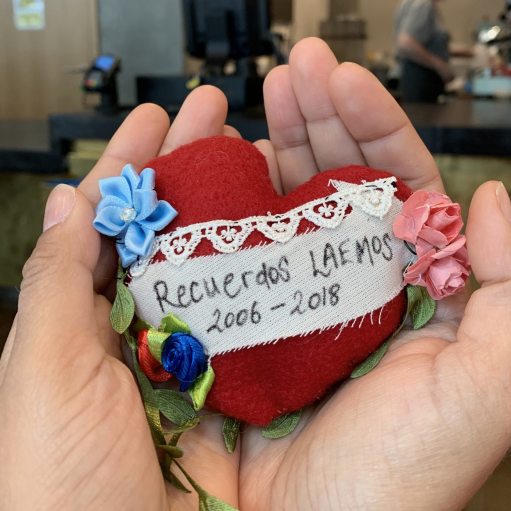
At the 2019 EGOS Board meeting in Edinburgh, members of the DA organised and posed a series of questions to the Board, led by scholars based in the Global North. This action was intentional in the way it recognised the relative safety and permanence that Northern academics possess in relation to Latin American critical scholars working in Business Schools. The champagne reception following on from the Board Meeting was disrupted by members of the DA who organised a banner-drop with the slogan, Recuerdos LAEMOS.
In 2022, DA members decided to respond to the International CMS conference call for papers and exhibitions entitled Being practically critical: Re-imagining possibilities for CMS, challenging the idea of a conference and (re)building our community of communities. A proposal was developed to launch Recuerdos LAEMOS, an oral history project, which has since had its first in-person installation at the ICMS conference in 2023, and now is manifesting in this digital archive. The creative team has since set out to explore radical possibilities to rebuild academic spaces through a collective remembering of the now disbanded LAEMOS conference.
 Epistemic Revivals